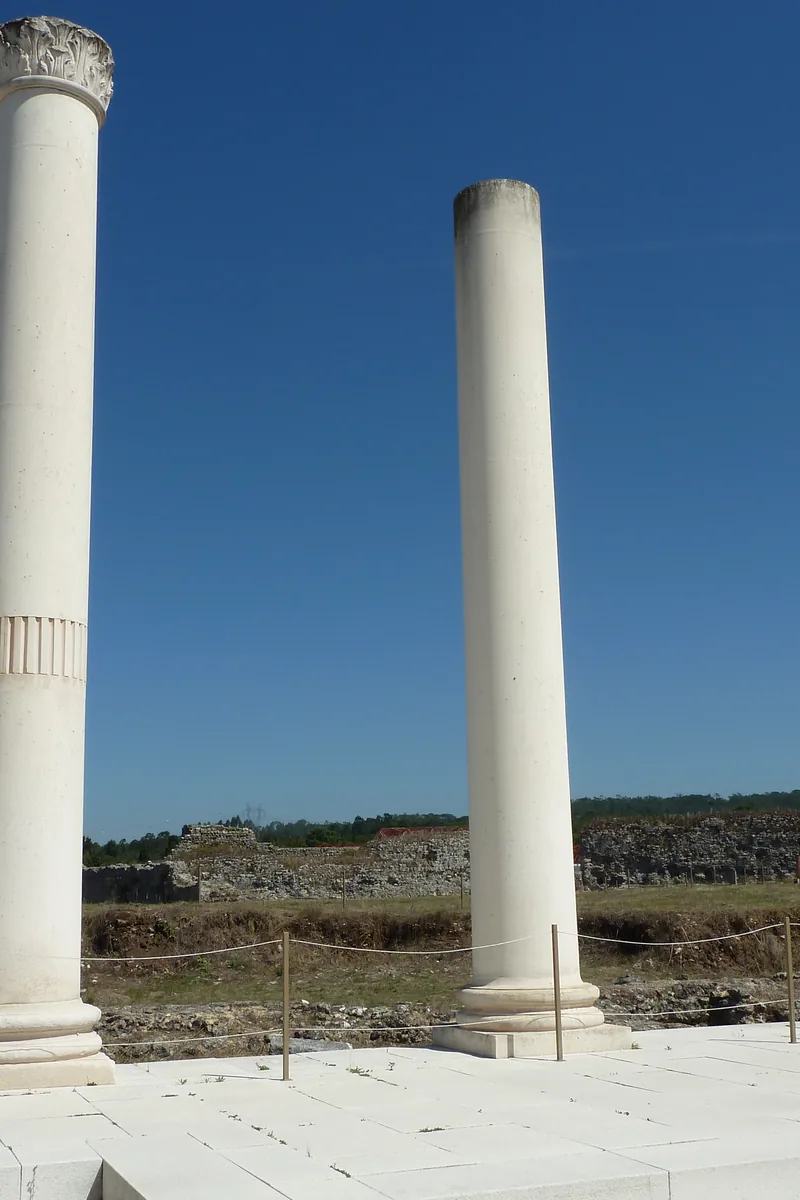
Reconstructed Corinthian columns standing over the excavated Roman town of Conímbriga, central Portugal, with the town's ruined stone walls stretching behind under a deep blue sky. One of Portugal's largest Roman archaeological sites, a National Monument since 1910.

The Roman city Portugal never finished burying

Conímbriga near Coimbra — one of the largest excavated Roman towns in Portugal. Walk the forum and the bath-houses, stand over the shimmering water-garden mosaics of the Casa dos Repuxos, and trace the emergency wall the townspeople drove straight through their own houses as the empire fell.

See ticket options
  • Largest The most extensively excavated Roman town in Portugal
  • AD 69–79 Raised to a Roman municipium under the Emperor Vespasian
  • Mosaics The Casa dos Repuxos — fountains that still dance over Roman floors
  • Since 1910 Classified a National Monument; ruins + museum on one ticket

Conímbriga tickets — choose your option

Pick the Conímbriga ticket that matches your group below. Each covers both the Roman ruins and the Monographic Museum, is dated entry valid any time on your chosen day, and is pre-bought by our concierge so you walk straight in at the visitor-centre desk.

Adult (ruins + museum)

Ages 25+ — or any age without a youth/senior ID

€22

  • Entry to the entire excavated Roman city of Conímbriga
  • The Casa dos Repuxos — the fountain house and its water-garden mosaics
  • The Casa de Cantaber, the forum, the bath-houses and the aqueduct
  • The Monographic Museum of Conímbriga — coins, glass, surgical tools, mosaics
  • Dated entry — arrive any time on your chosen day, no fixed slot
  • Mobile ticket — no printing needed
Notify me when bookings open

Youth (13–24)

Ages 13 to 24 — student or photo ID required at the gate

€15

  • Same full access as the Adult ticket — ruins and museum
  • The mosaics, forum, baths, walls and aqueduct
  • Bring photo ID showing age 13–24 — the operator checks at the desk
  • Mobile ticket — no printing needed
Notify me when bookings open

Senior (65+)

Ages 65+ — photo ID required at the gate

€15

  • Same full access as the Adult ticket — ruins and museum
  • The mosaics, forum, baths, walls and aqueduct
  • Bring photo ID showing age 65+ — the operator checks at the desk
  • Mobile ticket — no printing needed
Notify me when bookings open
  • Book in your languageYour currency, final price.
  • Pro tips includedBest hours, the mosaics before the crowds, the wall most miss.
  • Ready before you flyMobile ticket, ready in your inbox.
  • 24/7 human supportReal people, instant answers — any hour, any time zone.
4.9 from 87 verified travellers
Mark T.
Toronto, Canada
“The mosaics in the fountain house are unreal — better preserved than anything we saw in Rome. The concierge note told us to go there first before the coach group arrived, and we had it almost to ourselves.”
March 2026
Ingrid V.
Utrecht, Netherlands
“We based in Coimbra and the team's directions for the little bus out to Condeixa saved us a stressful morning. Ticket was in my inbox the night before.”
February 2026
Daniel R.
Manchester, UK
“That wall they built through their own town as Rome fell stopped me cold. My kids kept talking about it for days. Booking took two minutes.”
April 2026

5-minute audio guide

Your Conímbriga 5-minute guide

Hand-written, narrated by a heritage host. Five minutes across the greatest Roman town in Portugal — the water-garden mosaics, the forum and baths, and the desperate wall the townspeople drove through their own houses as the empire fell.

Included with your booking — your full guide arrives with your ticket.Get your guide
  • From Conii hillfort to Roman municipium under Vespasian
  • The Casa dos Repuxos — fountains that still play over the mosaics
  • The forum, the baths and the aqueduct from Alcabideque
  • The late-Roman wall, the Suebi sack, and why so much survives

Included free with every ticket. No app, no download — plays in any browser.

About Conímbriga

Conímbriga is one of the largest Roman towns excavated in Portugal — and the most extensively dug and best-preserved — spread across a low plateau near the village of Condeixa-a-Velha, about 16 kilometres south-west of Coimbra. The name is older than Rome's presence: it joins the pre-Roman word conim — 'a place of rocky height' — to the Celtic suffix briga, 'citadel'. People had lived on the site since the 9th century BCE, when the indigenous Conii and Castro-culture communities held the hill. When Roman armies pushed into central Lusitania around 139 BCE, Conímbriga was already a walled, built-up settlement sitting on the road that linked Olisipo (Lisbon) to Bracara Augusta (Braga) by way of Aeminium — the town that would later become Coimbra and take Conímbriga's name with it.

Under Roman rule the town flourished. Between AD 69 and 79 the emperor Vespasian raised Conímbriga to the rank of municipium, and a wave of building followed: a new forum with its basilica and temple, public baths fed by an aqueduct nearly three kilometres long, an amphitheatre, colonnaded streets and grand private houses. Judged by the seating its public buildings implied, the town held something like 10,000 people at its height. Italian colonist families — the Lucanii, the Murrii, the Vitellii — settled here and married into local Lusitanian families, and the archaeology captures that fusion in stone, glass and mosaic across three centuries of prosperity.

The two houses everyone comes for are the Casa dos Repuxos and the Casa de Cantaber. The Casa dos Repuxos — the House of the Fountains, or 'jets' — is a 2nd-century domus built around a central garden whose pools and playing water jets have been restored to run again; its floors are carpeted with some of the finest polychrome mosaics in the Iberian Peninsula, hunting scenes, the four seasons, mythological figures and geometric borders in astonishing preservation. The Casa de Cantaber, one of the largest private houses known anywhere in the western Roman Empire, sprawls across bath suites, courtyards and reception rooms. Between and around them run the shops, the streets and the great forum that make Conímbriga less a set of ruins than an actual readable town.

The most dramatic thing at Conímbriga is a wall. As the empire weakened in the late 3rd century, the townspeople threw up a massive new defensive rampart — and in their hurry they drove it straight through houses, streets and monuments, quarrying their own city for stone. It bought them time, but not enough: between 465 and 468 the Suebi sacked the town, and its people scattered. The bishop's seat moved to Aeminium — Coimbra — and Conímbriga slowly emptied, which is exactly why so much survives. It was never rebuilt over. Excavation began in earnest in the 19th century, the Monographic Museum opened on site to hold the finds, and today the ruins, the museum and the archaeological reserve are visited as one place on a single ticket.
Practical information

Address
Rua Professor Vergílio Correia, 3150-220 Condeixa-a-Velha, Portugal
Getting there
Conímbriga is 16 km south-west of Coimbra and about 2 km from the town of Condeixa-a-Nova. By car it is 15–20 minutes from Coimbra on the IC2 / N1, with free parking at the site entrance; from Lisbon it is roughly 2 hours on the A1 motorway (exit Condeixa), and from Porto about 1h30. Without a car, the simplest route is the Transdev 'Conímbriga' bus, which runs from Coimbra via Condeixa directly to the ruins on visiting days; alternatively take any Coimbra–Condeixa bus and complete the last 2 km by local taxi. Coimbra itself is on the main Lisbon–Porto rail line, so most international visitors base there.
Time needed
Allow two to three hours. The excavated city — forum, baths, streets, the great houses and the late-Roman wall — takes 90 minutes to two hours at a steady pace; the Monographic Museum adds 30–45 minutes. The site is open-air and largely unshaded, so the calmest and most comfortable windows are the first hour after opening (10:00) and the last two hours before the ticket office closes at 17:15. Midday in summer is both the hottest and the busiest.
What to wear
Comfortable closed shoes — the site is gravel paths, uneven Roman paving and low kerbs, with very little shade. In summer bring a hat, sunscreen and water; the plateau is fully exposed and central-Portugal afternoons reach the mid-30s °C. In winter it can be cold and wet, and the paving turns slick. A light layer helps year-round. There is a café and shop at the visitor centre by the entrance.
Accessibility
The visitor centre, museum and the main approach to the forum are on level, firm surfaces and are broadly wheelchair-accessible. Much of the excavated city, however, is original Roman paving, gravel and low steps that are uneven underfoot, and the Casa dos Repuxos is entered on raised walkways — parts of the deeper site are difficult for wheelchairs and unstable for those unsteady on their feet. Email us before your visit and we'll send the operator's current accessibility notes and the flattest suggested route.

About our service

Conímbriga Tickets acts as a facilitator to assist international visitors in purchasing tickets directly from the official operator. We do not resell tickets — we provide a personalised booking and support service in your own language. Our concierge service fee is included in the displayed price. For those who prefer to purchase directly, tickets are also available on the official website.

Frequently asked

Where do I go on the day, and is there a meeting point?

There's no meeting point with us — we are your booking concierge, not an on-site tour. Bring the QR ticket we email you to the visitor centre at the site entrance on Rua Professor Vergílio Correia in Condeixa-a-Velha. Staff scan your QR at the desk and you walk straight through to the ruins and museum. The ticket office closes at 17:15, so arrive before then.

Does one ticket cover both the ruins and the museum?

Yes. A single admission covers the entire excavated Roman city — the forum, the bath-houses, the great houses with their mosaics, the streets and the late-Roman walls — and the Monographic Museum of Conímbriga at the entrance. There is no separate ticket for the museum; it's all one visit.

Is photo ID required at the gate?

Only for the youth (13–24) and senior (65+) reduced tickets — bring a passport or government ID showing your age. The standard adult ticket does not require ID. Children under 13 enter free of charge and do not need a ticket booked through us.

What is the Casa dos Repuxos?

The Casa dos Repuxos — the House of the Fountains, or 'water jets' — is a 2nd-century Roman townhouse built around a central garden whose pools and playing fountains have been restored to run again. Its floors carry some of the best-preserved polychrome mosaics in the Iberian Peninsula: hunting scenes, the four seasons, mythological figures and intricate geometric borders. It is the single most famous thing at Conímbriga and, for most visitors, the reason to come.

What is the Casa de Cantaber?

The Casa de Cantaber is one of the largest private houses known in the entire western Roman Empire — a sprawling domus with its own private bath suite, multiple courtyards and reception rooms. It is named after Cantaber, a resident recorded by the historian Hydatius as having been captured with his family when the Suebi sacked the town in the 460s. Walking it gives you the scale of how a wealthy Roman-Lusitanian family actually lived.

Why is there a wall running through the middle of the town?

As the Roman Empire weakened in the late 3rd century, the people of Conímbriga built a massive new defensive wall in a hurry — and drove it straight through existing houses, streets and monuments, demolishing part of their own city and reusing the stone. It's one of the most vivid things at the site: you can see the wall cut across earlier Roman buildings. It delayed disaster but didn't prevent it — the Suebi sacked the town between 465 and 468.

Is Conímbriga a UNESCO World Heritage Site?

No. Conímbriga has been classified a Portuguese National Monument since 1910 and is on Portugal's UNESCO 'tentative list' of candidate sites, but it is not (yet) an inscribed World Heritage Site. It is, however, the most extensively excavated and best-preserved Roman town in the country.

How long should I allow for a visit?

Two to three hours is right for most people. The excavated city — forum, baths, streets, the great houses and the late-Roman wall — takes 90 minutes to two hours at a steady pace, and the Monographic Museum adds another 30–45 minutes. Photographers and history readers can easily spend longer among the mosaics.

What's the best time of day to visit?

The first hour after opening at 10:00, or the last two hours before the ticket office closes at 17:15. The site is open-air and mostly unshaded, so those windows are both the quietest and the coolest. Midday in summer is the hottest and the busiest, when the Casa dos Repuxos — which is small and roofed — can fill with groups.

Are children under 13 free?

Yes. Children under 13 enter free of charge and do not need a ticket booked through us — just bring them along. The ruins are a genuinely good place for kids: open space to explore, the running fountains, the mosaics and the dramatic story of the wall built through the town.

Can I take photographs?

Yes, for personal use. The mosaics of the Casa dos Repuxos and the restored water garden are the star subjects, and the whole open site photographs beautifully in low morning or late-afternoon light. Tripods and commercial photography may require an advance permit from the operator — ask us if you need one.

Is there shade, and what should I bring?

There is very little shade — Conímbriga sits on an exposed plateau. In summer bring a hat, sunscreen, sunglasses and water; central-Portugal afternoons reach the mid-30s °C. In winter and after rain the Roman paving can be slick, so bring closed, grippy shoes year-round. There is a café and shop at the visitor centre.

How do I get to Conímbriga from Coimbra?

It's 16 km south-west of Coimbra, about 15–20 minutes by car on the IC2 / N1 with free parking at the entrance. Without a car, the Transdev 'Conímbriga' bus runs from Coimbra via Condeixa-a-Nova directly to the ruins on visiting days; alternatively take any Coimbra–Condeixa bus and cover the last 2 km by local taxi. We send route notes with every booking.

Can I visit Conímbriga as a day trip from Lisbon or Porto?

Yes. From Lisbon it's about 2 hours by car on the A1 (exit Condeixa); from Porto about 1h30. Many international visitors instead base in Coimbra — on the main Lisbon–Porto rail line — and combine Conímbriga with the University of Coimbra and its Joanina Library, which are 16 km away. That pairing makes the most rewarding single day in the region.

Is the site accessible for wheelchairs or limited mobility?

Partly. The visitor centre, museum and the approach to the forum are level and firm; but much of the excavated city is original Roman paving, gravel and low steps that are uneven underfoot, and the Casa dos Repuxos is entered on raised walkways. Email us before your visit and we'll send the operator's accessibility notes and the flattest suggested route.

When is Conímbriga closed?

The site and museum are open daily 10:00–18:00 (last tickets 17:15). They close on 1 January, Easter Sunday, 1 May, 24 July, and 24–25 December. We won't issue a ticket for a closed date; if you pick one by mistake we'll flag it and rebook.

Can I change my visit date?

Email us at least 48 hours before your booked date and we'll rebook to any open date in the operator's calendar at no charge. Because Conímbriga is dated entry rather than a fixed time slot, date changes are usually straightforward. Inside 48 hours we'll do our best but can't always guarantee it.

Is there a refund if I can't make it?

Tickets are issued for a specific date and are non-transferable once issued. All sales are final. If your plans change, reply to your confirmation email at least 48 hours before your date and we'll rebook your visit to any open date in the operator's calendar. The only refund cases are operator-side failures such as an unscheduled closure.

Do you sell the ticket for more than the site charges?

The price you see includes our concierge service — booking on your behalf, support in your language, route and timing guidance, and re-sending your ticket before you travel. If you would rather buy the bare admission yourself, it is available on the official operator's website; our value is the service around it, not a marked-up ticket alone.

What is Conímbriga?

Conímbriga is one of the largest and the most thoroughly excavated Roman town in Portugal, near the village of Condeixa-a-Velha, about 16 kilometres south-west of Coimbra. Occupied since the 9th century BCE and raised to a Roman municipium by the emperor Vespasian between AD 69 and 79, it grew into a walled town of perhaps 10,000 people, with a forum, public baths fed by an aqueduct, an amphitheatre and grand private houses. Its floor mosaics — above all in the Casa dos Repuxos — are among the finest in the Iberian Peninsula. Sacked by the Suebi in the 460s and never rebuilt over, it has survived as an unusually complete Roman townscape, visited today with its on-site Monographic Museum on a single ticket.

How do Conímbriga tickets work — is there a fixed entry time?

No fixed time slot. Your ticket is dated entry, valid throughout opening hours (10:00–18:00, last tickets 17:15) on the day you choose, so you can arrive whenever suits your itinerary. We pre-buy your ticket from the official system, so on arrival you show the QR at the visitor-centre desk and go straight in. Staff scan the code on your phone — no printing needed.