 Skip-the-line available
 The History of Conímbriga
From Iron Age hillfort to Roman municipium to the emergency wall and the Suebi sack — the clear timeline.
Conímbriga has one of the clearest and most dramatic histories of any site in Portugal: an Iron Age hillfort that became a prosperous Roman town, braced for the fall of the empire with a wall driven through its own streets, was sacked by the Suebi, and then — crucially — was never rebuilt over. This guide is the factual timeline.
Before Rome — the Conii and the name
The plateau at Conímbriga was occupied from about the 9th century BCE, in the Iron Age, by indigenous Conii people and Castro-culture communities. The name records that pre-Roman past: conim, meaning a place of rocky height, joined to briga, the Celtic suffix for a citadel. When Roman forces reached central Lusitania around 139 BCE during the campaigns of Decimus Junius Brutus, Conímbriga was already a walled, built-up settlement.
Its position mattered. Conímbriga lay on the Roman road that linked Olisipo (Lisbon) to Bracara Augusta (Braga) by way of Aeminium — the nearby town that would later become Coimbra. That road, and the fertile country around it, set the town up to flourish under Roman rule.
The Roman town — 1st to 3rd centuries
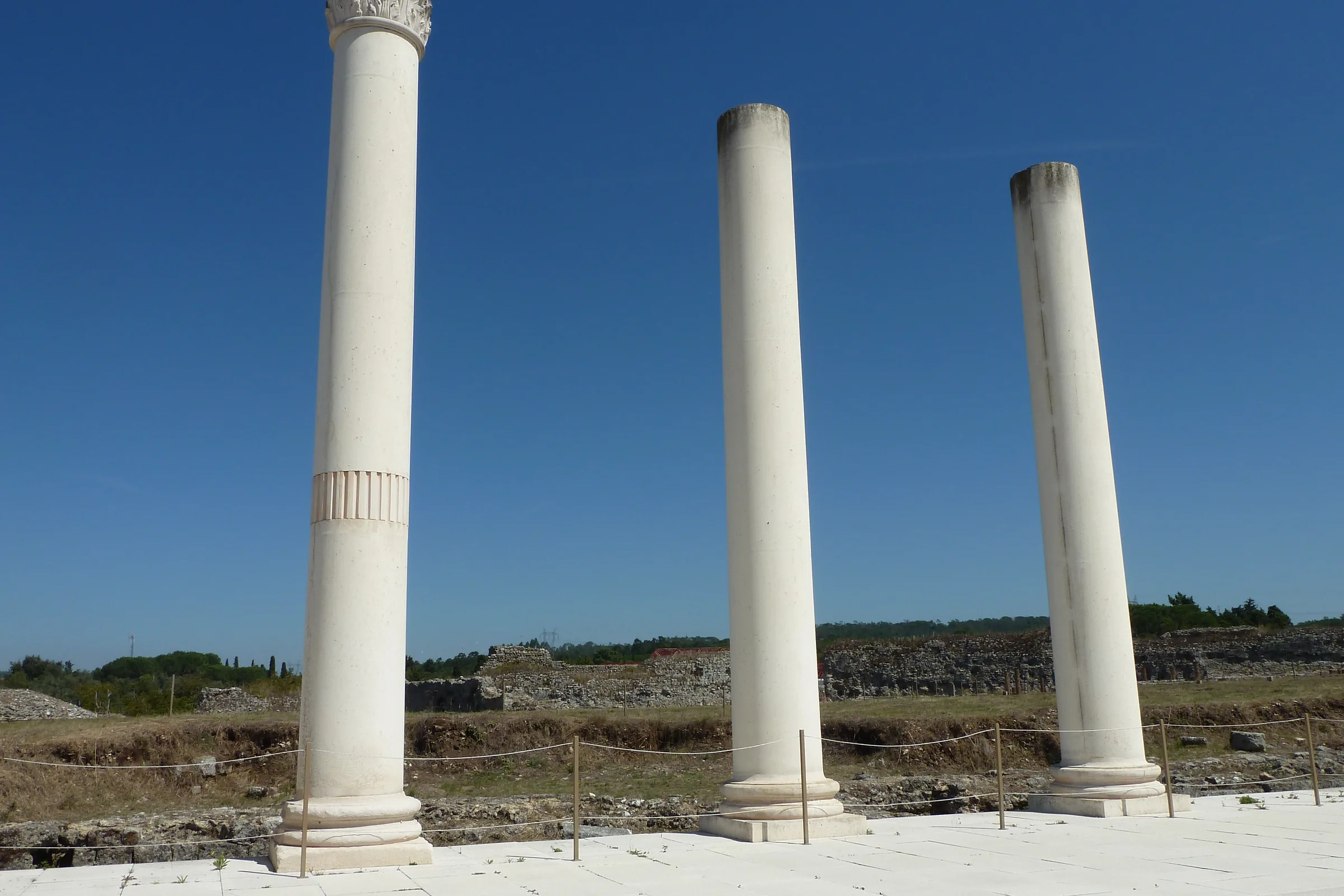
Under Rome the settlement was reorganised on formal lines and grew rapidly. Between AD 69 and 79 the emperor Vespasian raised Conímbriga to the rank of municipium, and a major building programme followed: a monumental forum with basilica and temple, public baths fed by an aqueduct nearly three kilometres long from the springs at Alcabideque, an amphitheatre, colonnaded streets and grand private houses. At its height the town held something like 10,000 people.
Colonist families from the Italian peninsula settled here and married into local Lusitanian families, and the archaeology captures that prosperous, hybrid society in stone, glass and mosaic. The greatest houses — the Casa dos Repuxos, built in the 2nd century, and the huge Casa de Cantaber — date from this long era of confidence, and their mosaics are among the finest in the Iberian Peninsula.
The wall and the fall
As the Roman Empire came under pressure in the late 3rd century, the townspeople built a massive new defensive wall around a reduced core of Conímbriga — and, in their haste, drove it straight through existing houses, streets and monuments, demolishing part of their own city and reusing the stone. The wall, visibly cutting across earlier buildings, is the most eloquent feature of the site: a town bracing for the end.
It delayed but did not prevent disaster. Between 465 and 468 the Suebi sacked Conímbriga; the 5th-century chronicler Hydatius recorded the event, including the capture of the family of Cantaber, one of the town's leading residents. Inhabitants were killed, enslaved or scattered, and the town began a long decline.
Abandonment, rediscovery and the museum
The bishop's seat established at Conímbriga in the 6th century was transferred to Aeminium by around 589; Aeminium took the old name, becoming Coimbra, and grew into the regional centre while Conímbriga emptied. Because it was never overbuilt by a medieval or modern town, the Roman townscape survived where others were buried under later centuries.
Conímbriga was classified a National Monument in 1910. Systematic excavation in the 19th and 20th centuries uncovered the forum, houses, baths and walls, and the on-site Monographic Museum was created to hold and display the finds — coins, glass, ceramics, sculpture, inscriptions and a notable collection of Roman surgical instruments. Today the ruins, the archaeological reserve and the museum are visited together as Portugal's largest and most complete Roman town. It sits on Portugal's UNESCO tentative list, though it is not yet an inscribed World Heritage Site.
Frequently asked
How old is Conímbriga?
The site was occupied from about the 9th century BCE by indigenous Conii and Castro-culture communities, long before the Romans arrived around 139 BCE. It became a Roman municipium under Vespasian between AD 69 and 79 and flourished into the 3rd century.
What does the name Conímbriga mean?
It joins conim, a pre-Roman word for a place of rocky height, to briga, the Celtic suffix meaning citadel. The nearby town of Aeminium later took the name and became Coimbra.
Who destroyed Conímbriga?
The Suebi, a Germanic people settled in north-western Iberia, sacked the town between 465 and 468 CE. The chronicler Hydatius recorded the event, including the capture of the family of Cantaber, a leading resident.
Why is Conímbriga so well preserved?
Because it was never rebuilt over. After the Suebi sack the population dispersed and the regional centre moved to Aeminium (Coimbra), leaving the Roman townscape in the fields rather than buried under a later medieval or modern town.
Was Conímbriga a big city?
By the standards of Roman Lusitania, yes — at its height it held roughly 10,000 people, with a forum, public baths, an aqueduct, an amphitheatre and grand private houses. It's one of the largest excavated Roman towns in Portugal.
Is Conímbriga a UNESCO World Heritage Site?
Not yet — it's a Portuguese National Monument (since 1910) on Portugal's UNESCO tentative list, but not an inscribed World Heritage Site. The nearby University of Coimbra, 16 km away, is inscribed, and the two pair well on one day.